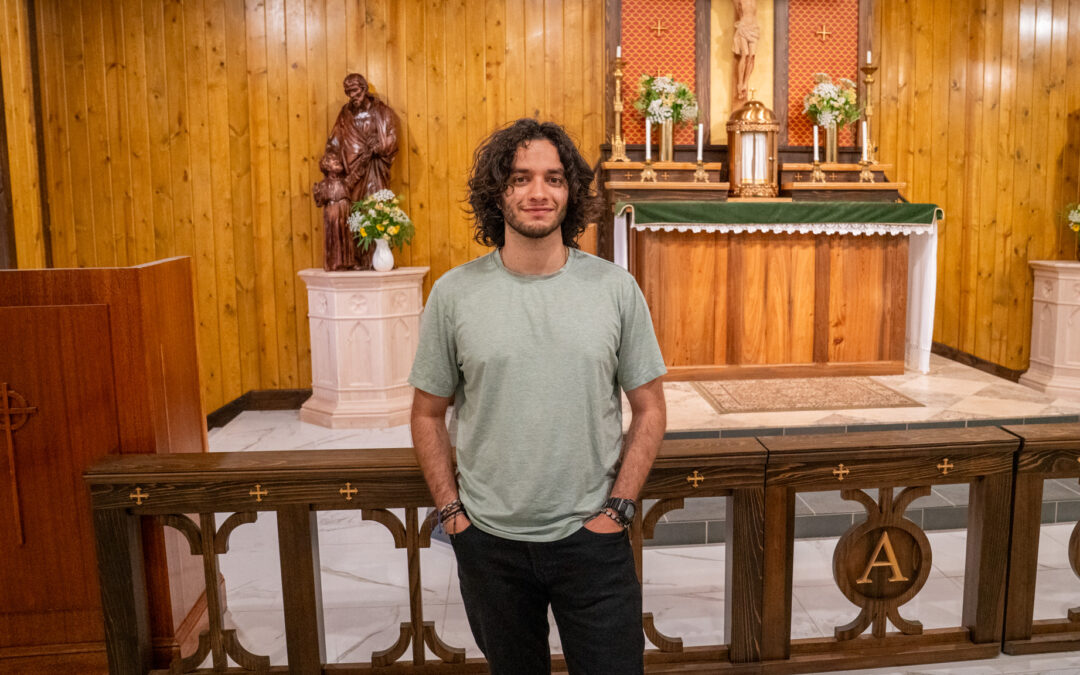
On May 5, 2026, while attending an event at Veritatis Splendor in Winona, Texas, Michael Iskander, who plays the titular character in Amazon’s hit show House of David, took part in an interview for the Catholic East Texas magazine.
CET: You play David in House of David. How did that happen?
MICHAEL ISKANDER: At the time, I was on Broadway where I was doing a musical called Kimberly Akimbo. We were running towards the end of production. I think at that point we had done 650 shows, close to 700, and we were going to close in April. I remember a few months prior, I got this audition and it was for David. It’s one of those things where you know a role comes around once in a lifetime. For me, David has always been my dream role. I called my mom and I told my family that David would be a character that I want to play. I submit the audition and every week, I check in with my team.
A month later, they came back and they said, “they sent off your tape to the producers, but we don’t know what happened, but I guess it’s not going to go your way.” It just didn’t work out, which happens all the time. That went on and I forgot about it. A few weeks later, I get a call from my agent. She says, “remember that David thing you auditioned for? Well, it’s back and they want you to reaudition.” Which is very rare. I talk to my mom again and she says, “don’t get too excited, because I want you to fast and I want you to pray. If you’re doing the show for God, this role for God, you must do it his way.” I fasted, prayed, I rehearsed my role, and I sent it in.
A week later, I got a call that Jon Erwin was going to fly out to New York and have a meeting with me. We ended up hanging out for four hours. They kicked us out of the table. It was a challenge to convince Amazon that this guy who has zero experience is the one that’s going to lead our show. It’s quite the ask. I appreciate Jon Gunn and Jon Erwin and everyone at Wonder Project for fighting for me, because they believed in me and they had my back. If it wasn’t for them, I wouldn’t be here. It’s the Lord’s blessing and the Holy Spirit that convinces people’s hearts. I’m thankful to God for this role and being able to tell the story.
CET: Praise God. Now you’re about to do a third season.
ISKANDER: Hopefully. Pray for us that we get a third season. We’re just waiting, but it’s up to the fans. We know that the market has needed a voice for Christ and people want to see their faith being represented on TV. Their views and clicks tell Amazon or Netflix that this is something that people are thirsty for and want to see this. If they don’t click, it’s just going to shut it down altogether. The support of the viewership and the support of the Church and the community is vital for this growth of faith-based media all around. It’s not just with House of David, but with The Chosen and The Passion of the Christ, and every project that is aiming to propel the faith into the world.
CET: How does a character like David resonate with people?
ISKANDER: Even as human beings, we can’t control someone’s conversion. It’s the Holy Spirit that encounters them. Our job is to represent the faith correctly and especially in media. It’s not just about accuracy, but it’s about the entertainment value. I think the story of David is so rich in that there doesn’t need to be a lot of creative liberty, but there are some liberties taken for the sake of TV storytelling or film storytelling. The story of David was the perfect story because, if you look at his life, he’s one of the most complex Bible characters ever.
He was a man who was chosen by God to be king in a country where there’s already a king. The political intrigue there provides such amazing value as an entertaining story. The most unlikely candidate to take down this giant since his youth is that same person. He goes down and takes the giant, then he becomes a commander. Then he becomes so famous and he’s a poet, and he’s handsome, and people love him. The king at the time becomes jealous, so he kicks him out of the kingdom, and then he’s being chased in the wilderness for years. Finally, he becomes king and has a huge downfall. He comes back up, has a downfall again, and comes back up.
David’s a whirlwind. That’s how good the story is. It was obvious as a next step in terms of faith-based storytelling. Of course, we’re going to tell the story of David, but David’s also important because the whole point of David is to point us to Christ. Christ is the fulfillment of that perfect priestly king who is promised. Everything about the heart of David is always pointing to God. This is not simply an amazing story. Many people have resonated with it, not just people in the Christian faith. For those in the Christian faith, David calls us for a deeper conversion and a deeper love for God.
CET: Walk me through what led to your conversion to Catholicism.
ISKANDER: I would say my conversion to Catholicism was a personal journey that I was on. I think for a long time I just felt thirsty for God. At a time where I didn’t go to church and I didn’t feel at home anywhere, I stepped into St. Patrick’s Cathedral, saw the altar, and realized that’s where the Eucharist is every day. The Lord is with us in the Eucharist every day. That’s something that I haven’t partaken in in a long time. It was the Eucharist that planted the seed of thinking about joining an Apostolic Church.
It sent me down to a lot of research. I’m not just going to be Catholic for fun. I must know what I’m getting myself into here. I have to make sure it’s the truth above everything else. It was about following the evidence, learning about history, the early Church Fathers, and the sacraments in an almost reversion way. I was baptized in the Coptic Orthodox Church and, for a while, I left. God has always been a part of my life, but it was just about learning to love him the way he wants to be loved.
CET: How has portraying David changed your prayer life?
ISKANDER: I think when doing a project like this, we face these spiritual battles. I don’t think we can ever get away with doing something for the Lord on such a scale and go be by ourselves and do our own thing. That’s not how it works. We have to be constantly with the Lord, in relationship with him, seeking his advice and wisdom, and be in prayer. Prayer is the communication between us and God. David influenced me in that he showed me the importance of prayer without ceasing. More importantly, loving God in a whole new way that I never understood before and I look to David to show me what it truly means to love God. David’s heart is so precious and so pure that God chose him out of everyone else to be king. When Jesus enters Jerusalem, he’s known as the Son of David, so this is a man that we need to pay attention to. We can’t just overlook him. There’s something about him that God wants us to focus on, something in his heart that God wants us to focus on. I learn from that daily in my spiritual life.
CET: What is your favorite prayer or scripture verse that you gravitate towards?
ISKANDER: There’s one that I like from the Book of Psalms. It’s Psalm 8:3. It begins with, when I look at your heavens, the work of your fingers, the moon, and the stars that you have established, what are human beings that you are mindful of them. Mortals that you care for them. Yet you have made them a little lower than God and crowned them with glory and honor. You have given them dominion over the works of your hands. You have put all things under their feet. This is David speaking, looking at the moon and the stars, the same ones that we look at today, in the same form and the same shape and the same light. They haven’t changed. He saw God in all of these little things. This moment shows his humility and how he’s a king. He is the highest of the high. Yet, he looks at God’s creation and is humbled by it and recognizes, “thank you, Lord, for all this beauty and thank you for all the honor that you have given us as humans even though we fail you.” This psalm is on the top of my list right now.
CET: One of my favorite lines in House of David is from season 1, when David says to God, “Lord, show me your purpose. Show me who I am.” How does that resonate with you?
ISKANDER: That’s a great point to bring up, and it was a point of discussion between me and the creative team because a huge sign of humility is the submission of one’s will even in the mundane. In season 1, David, as a young shepherd, is asking God, “Lord, is this it for me? Is this your will for me? Or is your will for me something greater?” David’s really asking, “Lord, what is it that you want me to do?” For me, I wanted to add a moment. The last line of season 2 is “Lord, show me your will. Show me your purpose for your kingdom.” I wrote that bit. There was already a prayer there. Then I switched it up and told the creative team that there must be some level of growth here for David. Maybe if he’s younger, he’s seeking God and asking, “what do you want from me? What is it that I’m supposed to do?” But then later, as he goes through all these challenges and all these battles, he realizes that it’s not actually about him. He’s there to serve, and God is going to lead him out of it. In a way, this prayer shows how far he has come in terms of maturity, intelligence, and his ability to submit to God’s will. In that specific moment, it is the same kind of prayer but tweaked a little bit for who he is later at the end of season 2. That was a very poignant moment that I wanted to point out so I’m glad you noticed it.
CET: What advice would you give to Catholics who struggle with their spiritual life?
ISKANDER: Sometimes when someone is struggling with their spiritual life, there’s an amount of love there that is either not seen or not felt. We want to be around the things that make us happy and make us full and feel alive. The reason I came back to the Church is because I felt alive. In comparison to what I felt before where I felt dead. It was like a man in a car crash, his heart stopped, and the EMTs are shocking him, and they finally get a heartbeat, and he takes his first breath. That’s what the Catholic Church is to me.
Worshiping the Lord is what I’m gravitated to. If someone is not feeling that, I would say, it’s sad because I think there’s so much to explore in the faith. I urge them to pray from the heart and ask the Lord to encounter them in a way that they haven’t before. That way, they can serve and love him, feel this love that he has for all of us, and experience it because it’s life-changing.
The faith isn’t just about feelings, but it’s about eternal life. Everything that is good in the world comes from God, whether we realize it or not. It’s a hard question because many people struggle with it. I’ve struggled with it and it wasn’t until God broke me down that He was able to build me back up. Often, for us to grow with him, he has to destroy everything that we have made our idols, everything that we have built that’s not on the rock. Then when we ask him to intervene, He will destroy and it will be painful, but He will build again. Be careful how you pray because of the way it can be answered.
CET: For Catholics trying to break into a career in acting, what advice would you give them?
ISKANDER: I would say don’t compromise on your morals. Don’t compromise on God. Honor him first. If this is something that He wills for you, it’ll happen in his time. I recognize that my situation is very rare. I’m 24 years old and to get an opportunity like this is not something that I ever take for granted. I know it’s a tremendous blessing, but that’s not the situation for everybody. Even in the industry, if you “make it,” that’s not how it works there. It’s a constant battle and struggle. The people who are truly successful in this industry are the ones who put their heads down, do the work, and are humble. They just care about the story most of all. Be skilled at your craft. The Lord doesn’t want you to come and show up haphazardly. Do the work, work hard, and be excellent for him. He will bless the rest.
CET: What were your favorite movies growing up?
ISKANDER: My favorite movie ever is called Meet the Robinsons. I saw Project Hail Mary recently, so it’s Project Hail Mary and The Secret Life of Walter Mitty in second place right now. The Passion of the Christ is a pretty fantastic film. Seven with Brad Pitt and Morgan Freeman is a good one. It has these biblical themes throughout about how the seven deadly sins lead to death. It’s also a very complex situation. It was very well-acted, very well-produced, and I think it’s the perfect noir type of storytelling. It was very well done. It’s very difficult to watch, but it was worth the story for sure. There’s a film that came out recently called Triumph of the Heart about St. Maximilian Kolbe. That one also has some tough scenes, but I think sometimes, without those tough scenes, it’s hard to grasp the gravitas of what’s actually happening.
CET: The best kind of movie is the kind that impacts you in a positive way and helps you grow in your relationship with God.
ISKANDER: Absolutely. It’s asking the question: why are we storytellers? Why do we tell different stories? In ancient times, it was to hold tradition. The oral tradition was passed down that way. Film and TV are just fancier versions of that. They hold these themes of virtue. For Meet the Robinsons, it’s adoption and how adoption is an amazing story and how family is not just by blood, but family is the people you love unconditionally regardless of whether they do anything for you or not. With The Secret Life of Walter Mitty, it’s about how we already have everything we need, and we don’t even realize it. It’s not until we go through the journey of life and we go through our ups and downs that we realize that we had it all along right next to us. I tend to gravitate towards those films that are virtuous in nature.
CET: Regarding season 3 of House of David, what are you allowed to talk about?
ISKANDER: We are just waiting for season 3. There’s nothing for me to say. I think we can guess if you read the Bible what’s up next for David. It follows this theme of shepherd, poet, king. I think we’re definitely going to see David become king in this next season. If people don’t know that, just read your Bible (laughs).
CET: What would get you most excited about a potential season 3?
ISKANDER: What gets me most excited is following the theme of a priestly king. As we’ve seen David grow in his relationship with God, this is David in his prime, not only in his stature and his leadership, but in his relationship with God. Hopefully, we see David embrace God’s will for him and revel in the unknown. Because there is so much unknown up until he becomes king, and a lot of growing with God, I don’t know what the next steps are. Until God reveals that to me, I’m going to wait on the Lord and those who wait on the Lord shall renew their strength. I don’t know much about season 3.
CET: Any upcoming projects that you’ve got going on?
ISKANDER: Maybe. There might be some stuff that’s upcoming. Maybe a mobile in the mix. A pope mobile in the mix. There might be a little tour happening.
At the end of June, Michael Iskander will host the pope mobile across the United States to help children affected by war, travelling to thirteen cities. Each city will commemorate an American Catholic hero and have a Catholic celebrity. The event will be documented on YouTube.
House of David seasons 1 and 2 are now available to stream on Amazon Prime.
Personificando al ungido de Dios: Una entrevista con Michael Iskander
El 5 de mayo de 2026, mientras asistía a un evento en Veritatis Splendor en Winona, Texas, Michael Iskander, quien interpreta al personaje principal de la serie exitosa de Amazon House of David, participó en una entrevista para la revista Catholic East Texas.
CET: Interpretas a David en House of David. ¿Cómo sucedió eso?
MICHAEL ISKANDER: En aquel tiempo, estaba en Broadway, donde actuaba en un musical llamado Kimberly Akimbo. Nos acercábamos al final de la temporada. Creo que para ese tiempo habíamos dado unas 650 funciones, casi 700, e íbamos a terminar en abril. Recuerdo que unos meses antes me llamaron para una audición y era para el papel de David. Es una de esas cosas en las que sabes que un papel así solo se presenta una vez en la vida. Para mí, David siempre ha sido el papel de mis sueños. Llamé a mi mamá y le dije a mi familia que David sería un personaje que quería interpretar. Presenté la audición y cada semana me comunicaba con mi equipo.
Un mes después, me respondieron y me dijeron: «Enviaron tu grabación a los productores, pero no sabemos qué pasó, así que supongo que no te va a salir como esperabas». Simplemente no funcionó, lo cual pasa todo el tiempo. Eso siguió así y me olvidé del asunto. Unas semanas más tarde, recibí una llamada de mi agente. Ella me dijo: «¿Te acuerdas lo de David para la que te presentaste a la audición? Pues ha vuelto a salir y quieren que vuelvas a hacer la audición». Es rara vez que suceda esto. Hablé con mi mamá otra vez y me dijo: «No te emociones demasiado, porque quiero que ayunes y que ores. Si vas a hacer el programa para Dios, este papel para Dios, debes hacerlo a su manera». Ayuné, oré, ensayé mi papel y lo envié.
Una semana después, recibí una llamada en la que me dijeron que Jon Erwin iba a volar a Nueva York para reunirse conmigo. Terminamos pasando cuatro horas juntos. Nos echaron de la mesa. Fue un reto convencer a Amazon de que este chico sin experiencia era el indicado para liderar nuestro programa. Es mucho pedir. Agradezco a Jon Gunn y a Jon Erwin, y a todos en Wonder Project, por luchar por mí, porque creyeron en mí y me apoyaron. Si no fuera por ellos, no estaría aquí. Es la bendición del Señor y el Espíritu Santo lo que convence los corazones de las personas. Le doy gracias a Dios por este papel y por poder contar la historia.
CET: Alabado sea Dios. Ahora están a punto de hacer una tercera temporada.
ISKANDER: Ojalá. Oren por nosotros para que tengamos una tercera temporada. Estamos a la espera, pero depende de los fans. Sabemos que el mercado ha necesitado una voz para Cristo y que la gente quiere ver representada su fe en la televisión. Sus visitas y clics le dicen a Amazon o Netflix que esto es algo que la gente anhela y quiere ver. Si no hacen clic, simplemente lo cancelarán por completo. El apoyo de la audiencia y el apoyo de la Iglesia y la comunidad es vital para el crecimiento de los medios basados en la fe en general. No es solo con House of David, sino con The Chosen y La Pasión de Cristo, y con cada proyecto que tiene como objetivo promover la fe en el mundo.
CET: ¿Cómo es que un personaje como David llega al corazón de la gente?
ISKANDER: Como seres humanos, no podemos controlar la conversión de nadie. Es el Espíritu Santo quien se encuentra con ellos. Nuestra tarea es representar la fe de manera correcta, especialmente en los medios de comunicación. No se trata solo de la precisión, sino también del valor de entretenimiento. Creo que la historia de David es tan rica que no hace falta mucha libertad creativa, pero se han tomado algunas libertades por el bien de la narración televisiva o cinematográfica. La historia de David era perfecta porque, si observas su vida, es uno de los personajes bíblicos más complejos que existen.
Era un hombre elegido por Dios para ser rey en un país donde ya había un rey. Las intrigas políticas que hay allí aportan un valor increíble como historia entretenida. El candidato más improbable para derrotar a este gigante desde su juventud es esa misma persona. Va y derrota al gigante, luego se convierte en comandante. Después se vuelve muy famoso, es poeta, es guapo y la gente lo ama. El rey de ese entonces se pone celoso, así que lo echa del reino, y luego lo persiguen por el desierto durante años. Finalmente, se convierte en rey y sufre una gran caída. Se recupera, vuelve a caer y se recupera de nuevo.
David es un huracán. Así de buena es la historia. Era obvio como siguiente paso en términos de narración basada en la fe. Por supuesto, vamos a contar la historia de David, pero David también es importante porque el objetivo de David es señalarnos a Cristo. Cristo es el cumplimiento de ese rey-sacerdote perfecto que fue prometido. Todo lo que hay en el corazón de David siempre apunta a Dios. No se trata simplemente de una historia increíble. Muchas personas se han identificado con ella, no solo los cristianos. Para los que profesamos la fe cristiana, David nos llama a una conversión más profunda y a un amor más profundo por Dios.
CET: Cuéntame qué te llevó a convertirte al catolicismo.
ISKANDER: Diría que mi conversión al catolicismo fue un camino personal que recorrí. Creo que durante mucho tiempo simplemente sentí sed de Dios. En un momento en el que no iba a la iglesia y no me sentía en casa en ningún lado, entré a la Catedral de San Patricio, vi el altar y me di cuenta de que ahí es donde está la Eucaristía todos los días. El Señor está con nosotros en la Eucaristía todos los días. Eso es algo de lo que no había participado en mucho tiempo. Fue la Eucaristía la que sembró la semilla de pensar en unirme a una Iglesia Apostólica.
Eso me llevó a investigar mucho. No voy a ser católico solo por diversión. Debo saber en qué me estoy metiendo. Tengo que asegurarme de que sea la verdad por encima de todo lo demás. Se trataba de seguir las pruebas, aprender sobre la historia, los primeros Padres de la Iglesia y los sacramentos, casi como una reconversión. Fui bautizado en la Iglesia Ortodoxa Copta y, por un tiempo, la dejé. Dios siempre ha sido parte de mi vida, pero se trataba simplemente de aprender a amarlo de la manera en que Él quiere ser amado.
CET: ¿Cómo ha cambiado tu vida de oración el hecho de interpretar a David?
ISKANDER: Creo que, al llevar a cabo un proyecto como este, nos enfrentamos a estas batallas espirituales. No creo que podamos hacer algo para el Señor a tal escala y luego irnos por nuestra cuenta a hacer lo que nos dé la gana. Así no es como funciona. Tenemos que estar constantemente con el Señor, en relación con Él, buscando su consejo y sabiduría, y estar en oración. La oración es la comunicación entre nosotros y Dios. David me influyó al mostrarme la importancia de orar sin cesar. Más importante aún, amar a Dios de una manera completamente nueva que nunca había entendido antes, y miro a David para que me muestre lo que verdaderamente significa amar a Dios. El corazón de David es tan precioso y tan puro que Dios lo eligió entre todos los demás para ser rey. Cuando Jesús entra en Jerusalén, se le conoce como el Hijo de David, así que este es un hombre al que debemos prestar atención. No podemos simplemente ignorarlo. Hay algo en él en lo que Dios quiere que nos centremos, algo en su corazón en lo que Dios quiere que nos centremos. Aprendo de eso a diario en mi vida espiritual.
CET: ¿Cuál es tu oración o versículo bíblico favorito que te atrae?
ISKANDER: Hay uno que me gusta del Libro de los Salmos. Es el Salmo 8:3. Comienza diciendo: «Cuando contemplo tus cielos, obra de tus dedos, la luna y las estrellas que tú has creado, ¿qué es el ser humano para que te acuerdes de él? Mortales a quienes cuidas. Sin embargo, los has hecho un poco inferiores que Dios y los has coronado de gloria y honor. Les has dado dominio sobre las obras de tus manos. Has puesto todas las cosas bajo sus pies». Esto lo dice David, al mirar la luna y las estrellas, las mismas que miramos hoy, con la misma forma y la misma luz. No han cambiado. Él vio a Dios en todas estas cosas pequeñas. Este momento muestra su humildad y cómo es un rey. Él es el más alto de los altos. Sin embargo, mira la creación de Dios y se siente humilde ante ella y reconoce: «Gracias, Señor, por toda esta belleza y gracias por todo el honor que nos has dado como seres humanos, aunque te fallamos». Este salmo está en lo más alto de mi lista en este momento.
CET: Una de mis frases favoritas de House of David es de la primera temporada, cuando David le dice a Dios: «Señor, muéstrame tu propósito. Muéstrame quién soy». ¿Cómo impacta eso en ti?
ISKANDER: Es un excelente punto que mencionas, y fue un tema de discusión entre el equipo creativo y yo, porque una gran muestra de humildad es la sumisión de la propia voluntad incluso en lo mundano. En la primera temporada, David, como pastor joven, le pregunta a Dios: «Señor, ¿esto es todo para mí? ¿Es esta tu voluntad para mí? ¿O tu voluntad para mí es algo más grande?». David realmente está preguntando: «Señor, ¿qué es lo que quieres que haga?». En mi caso, quise agregar un momento. La última frase de la segunda temporada es: «Señor, muéstrame tu voluntad. Muéstrame tu propósito para tu reino». Yo escribí esa parte. Ya había una oración ahí. Luego la cambié y le dije al equipo creativo que debía haber algún nivel de crecimiento aquí para David. Tal vez si es más joven, está buscando a Dios y preguntando: «¿Qué quieres de mí? ¿Qué se supone que debo hacer?» Pero luego, a medida que atraviesa todos estos desafíos y todas estas batallas, se da cuenta de que en realidad no se trata de él. Está ahí para servir, y Dios lo va a sacar de eso. En cierto modo, esta oración muestra lo lejos que ha llegado en términos de madurez, inteligencia y su capacidad para someterse a la voluntad de Dios. En ese momento específico, es el mismo tipo de oración, pero ajustada un poco para quien es él más adelante, al final de la segunda temporada. Ese fue un momento muy conmovedor que quería destacar, así que me alegra que lo hayas notado.
CET: ¿Qué consejo le darías a los católicos que tienen dificultades con su vida espiritual?
ISKANDER: A veces, cuando alguien tiene dificultades con su vida espiritual, hay una cantidad de amor ahí que no se ve o no se siente. Queremos estar rodeados de las cosas que nos hacen felices, nos llenan y nos hacen sentir vivos. La razón por la que regresé a la Iglesia es porque me sentí vivo. En comparación con lo que sentía antes, cuando me sentía muerto. Fue como un hombre en un accidente automovilístico, se le paró su corazón, y los paramédicos le aplicaron descargas eléctricas hasta que finalmente lograron que su corazón latiera y él tomara su primer aliento. Eso es lo que la Iglesia católica significa para mí.
Adorar al Señor es lo que me atrae. Si alguien no siente eso, diría que es triste porque creo que hay mucho por explorar en la fe. Los animo a que recen desde el corazón y a pedirle al Señor que se les revele de una manera que no hayan experimentado antes. De esa manera, pueden servirlo y amarlo, sentir este amor que Él tiene por todos nosotros y experimentarlo porque cambia la vida.
La fe no se trata solo de sentimientos, sino de la vida eterna. Todo lo que es bueno en el mundo viene de Dios, nos demos cuenta o no. Es una pregunta difícil porque a mucha gente le cuesta. Yo he luchado con ella y no fue hasta que Dios me derribó que pudo reconstruirme. Muchas veces, para que crezcamos con Él, tiene que destruir todo lo que hemos convertido en nuestros ídolos, todo lo que hemos construido que no está sobre la roca. Entonces, cuando le pedimos que intervenga, Él destruirá y será doloroso, pero Él reconstruirá. Ten cuidado con cómo rezas debido a la forma en que puede ser respondida.
CET: Para los católicos que desean dedicarse a la actuación, ¿qué consejo les darías?
ISKANDER: Les diría que no renuncien a sus principios morales. Que no renuncien a Dios. Que le honren a Él ante todo. Si esto es lo que Él quiere para ustedes, sucederá a su debido tiempo. Soy consciente de que mi situación está fuera de lo común. Tengo 24 años y tener una oportunidad como esta no es algo que tome a la ligera. Sé que es una bendición tremenda, pero esa no es la situación de todos. Incluso en la industria, si «triunfas», no es así como funciona allí. Es una batalla y una lucha constantes. Las personas que realmente tienen éxito en esta industria son aquellas que se concentran, hacen el trabajo y son humildes. A ellos, más que nada, les importa la historia. Sé hábil en tu trabajo. El Señor no quiere que vengas y te presentes a medias. Haz el trabajo, trabaja duro y sé excelente para Él. Él bendecirá el resto.
CET: ¿Cuáles eran tus películas favoritas cuando eras niño?
ISKANDER: Mi película favorita es Meet the Robinsons. Hace poco vi Project Hail Mary, así que ahora Project Hail Mary y La vida secreta de Walter Mitty ocupan el segundo lugar. La Pasión de Cristo es una película bastante fantástica. Seven, con Brad Pitt y Morgan Freeman, es muy buena. Tiene temas bíblicos a lo largo de toda la trama sobre cómo los siete pecados capitales conducen a la muerte. También es una situación muy compleja. Estuvo muy bien actuada, muy bien producida, y creo que es el tipo perfecto de narrativa noir. Estuvo muy bien hecha. Es muy difícil de ver, pero sin duda valió la pena por la historia. Hay una película que se estrenó recientemente llamada El triunfo del corazón, sobre San Maximiliano Kolbe. Esa también tiene algunas escenas duras, pero creo que a veces, sin esas escenas duras, es difícil captar la gravedad de lo que realmente está sucediendo.
CET: El mejor tipo de película es aquella que te impacta de manera positiva y te ayuda a crecer en tu relación con Dios.
ISKANDER: Por supuesto. Se trata de hacer la pregunta: ¿por qué somos narradores? ¿Por qué contamos diferentes historias? En la antigüedad, era para preservar la tradición. La tradición oral se transmitía de esa manera. El cine y la televisión son simplemente versiones más sofisticadas de eso. Contienen estos temas de virtud. En el caso de Meet the Robinsons, se trata de la adopción y de cómo la adopción es una historia increíble, y de cómo la familia no es solo una relación de sangre, sino que la familia son las personas a las que amas incondicionalmente, independientemente de si hacen algo por ti o no. En La vida secreta de Walter Mitty, se trata de cómo ya tenemos todo lo que necesitamos y ni siquiera nos damos cuenta. No es hasta que recorremos el camino de la vida y pasamos por nuestros altibajos que nos damos cuenta de que lo teníamos todo el tiempo a nuestro lado. Me atraen las películas que son de naturaleza virtuosa.
CET: En cuanto a la tercera temporada de House of David, ¿de qué puedes hablar?
ISKANDER: Estamos esperando la tercera temporada. No hay nada que pueda decir. Creo que si leen la Biblia, pueden adivinar lo que le espera a David. Sigue esta temática de pastor, poeta, rey. Creo que definitivamente veremos a David convertirse en rey en la próxima temporada. Si la gente no lo sabe, que lean la Biblia (se ríe).
CET: ¿Qué es lo que más te entusiasma de una posible tercera temporada?
ISKANDER: Lo que más me entusiasma es seguir la temática del rey-sacerdote. A medida que hemos visto crecer a David en su relación con Dios, este es David en su mejor momento, no solo en cuanto a su estatura y su liderazgo, sino también en su relación con Dios. Ojalá veamos a David aceptar la voluntad de Dios para él y disfrutar de lo desconocido. Como hay tantas incertidumbres hasta que se convierte en rey, y tanto crecimiento con Dios, no sé cuáles serán los próximos pasos. Hasta que Dios me lo revele, voy a esperar en el Señor, y los que esperan en el Señor renovarán sus fuerzas. No sé mucho sobre la tercera temporada.
CET: ¿Tienes algún proyecto en camino?
ISKANDER: Quizás. Puede que haya algunas cosas en camino. Quizás algo relacionado con un móvil. Algo relacionado con el papamóvil. Puede que haya una pequeño tour.
A finales de junio, Michael Iskander llevará el papamóvil por todo Estados Unidos para ayudar a los niños afectados por la guerra, visitando trece ciudades. En cada ciudad se conmemorará a un héroe católico estadounidense y contará con la presencia de una celebridad católica. El evento se transmitirá en YouTube.
La primera y segunda temporada de House of David ya están disponibles en Amazon Prime.