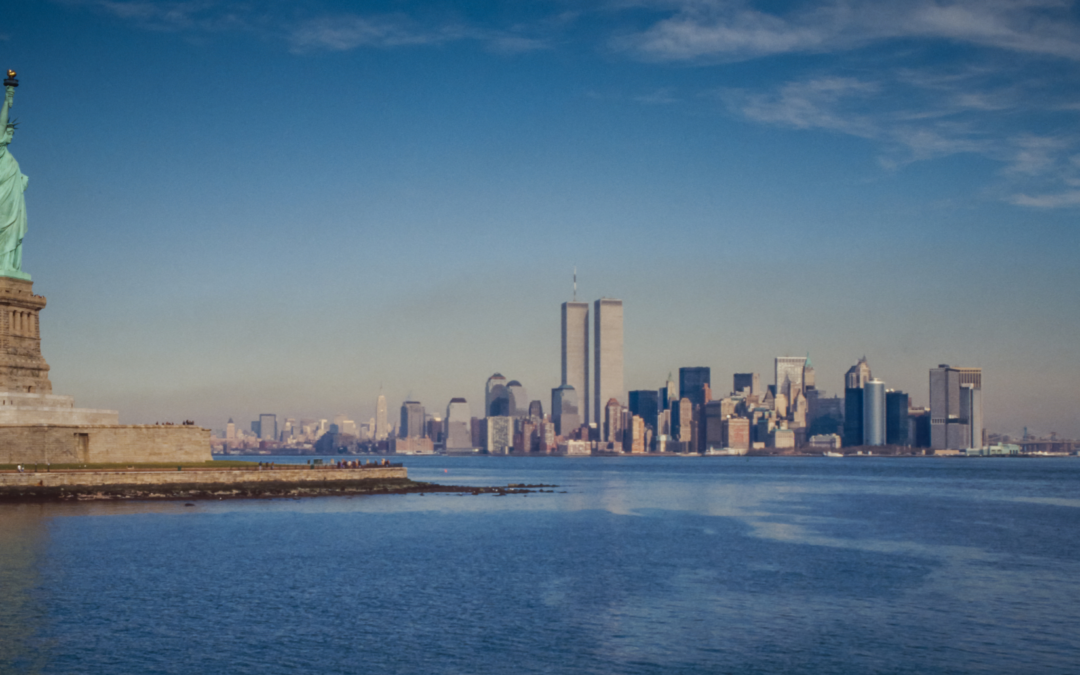
September 11, 2001. It is one of those dates people remember exactly where they were and what they were doing when the news came: planes flying into the Twin Towers. An image played over and over on that clear, bright September day. Another plane flying into the Pentagon. A fourth brought down in a field in Pennsylvania due to the heroics of the passengers. So much confusion and fear and uncertainty. What does this mean? What happens next? So many stories of heroism, of small instances that saved a person’s life or ended it. Something as simple as getting in early that day or arriving late. So much sorrow spread into the lives of so many people, rippling out, flooding out, into the lives of people all across the country and around the world.
How do we face such unbearable sorrow? How do we face these things and understand them. Where is God within them?
Bishop Erik Varden of Norway preached the papal retreat this past Lent.* In one of his conferences, God’s Help, he reflects on the Book of Job and the disaster that befalls Job. The entire biblical book treats of this disaster and of Job’s response, his lament in the face of it, and his resistance to the easy answers and platitudes offered by his friends as to why this happened to him. They attempt to defend God and God’s goodness in the midst of this. They urge Job to confess some secret sin that has caused his suffering.
Reflecting on the work of another author, Marion Muller-Colard, Bishop Varden notes that the Book of Job proceeds in three steps as three movements of a symphony, the first being Lament. Job laments. He cries out of a deep, age-old sorrow: “let the day perish wherein I was born, and the night that said, ‘A man-child is conceived.’” (Job 3:3) He demands an explanation from God. He protests his innocence.
The second movement is Menace. “It represents the realization that faith in God does not amount to safety…[Job]has lived justly…His loss has taught him that he stands unprotected.” Bishop Varden notes, “Physicians and pastors tend to fix their attention on the individual bruises when, in fact, what is at stake is the vast, all-encompassing trauma of devastating questions: ‘What if, after all, nothing makes sense? What if God does not help?’” (Varden 27 & 28)
The third movement is the discovery of Grace. This begins halfway through the Book of Job. It is signaled when Job, living for a long time in the darkness of lament and menace cries out, “I know that my Redeemer lives, and that at the last he will stand upon the earth…and my eyes shall behold and not another.” (Job 19:25f) Only at the end of the book does Job come to a new perception of the immensity of the mystery of God, who alone is able to bring order out of chaos as he did in the very beginning (Gen 1:1f) and does in every moment. Job says, “I had heard of you by the hearing of the ear, now my eye sees you.” (Job 42:5)
In our faith the central moment of God bringing order out of chaos is the crucifixion and death of Jesus. It is a devastating moment for his followers. It was, unbeknownst to them, a prelude to the resurrection and a new life they could scarcely imagine or foresee.
The 25th anniversary of this devastating day, September 11, 2001, also moves within this larger mystery of God’s all-embracing love. We live within the mystery of God’s help. We live within his providence. This providence, this grace, sustains us in all things, especially within the large and small tragedies of our world, and within the victorious mystery of that all-embracing love which makes all things new. (Cf. Rev. 21:5)
*Bishop Erik Varden, Alight with Hidden Glory: The 2026 Papal Retreat, Bloomsbury, 2026.
A PATRIOT DAY PRAYER – (XAVIER UNIVERSITY)
Holy God,
Creator of all people and all nations,
it is with sorrow and apprehension that we remember the tragic events
that occurred on this day.
We lift to you in prayer all those who died
in the Twin Towers, at the Pentagon,
and on United Airlines Flight 93 in Shanksville, Pennsylvania.
We entrust them to your loving care.
Console their families, friends, and all who mourn this loss
in the hope that all who trust in you find peace and rest in your Kingdom.
We pray for those who courageously responded to provide aid and comfort to the afflicted.
May their painful memories of that day
be healed and transformed into strength and positive resolution.
We also pray for ourselves as we seek your strength and guidance.
We live in the aftermath of this tragedy and under the shadow of future acts of aggression;
we stand in need of Your assistance.
Enable us, dear God, to put an end to fear:
by resolving to live lives that are based on respect for one another;
by resolving to abide in a peaceful manner
and never settle disagreements in our lives in a violent way;
by resolving not to fall into the trap of blaming entire ethnic groups, races, or religions
in response to acts of hostility;
and by resolving that justice, not revenge, prevails in our world.
Let us resolve that in the face of hatred, we will show love;
that in times of despair, we will be voices of hope
and creators of new dreams;
that in times of darkness, we will be sources of light.
Let us resolve that we never regard forgiveness as weakness,
But rather as a source of strength in our lives and in our world.
And, let us honor the memory of nearly 3,000 individuals who died on September 11, 2001
by resolving, with your help, almighty God,
to truly live this way, so you may be glorified
and your love made known to others through us. Amen.
© JesuitResource.org