“The Church, like a mother, accompanies those who are walking. Where the world sees threats, she sees children; where walls are built, she builds bridges. She knows that her proclamation of the Gospel is credible only when it is translated into gestures of closeness and welcome. And she knows that in every rejected migrant, it is Christ himself who knocks at the door of the community.” – Pope Leo XIV, Dilexi Te (I have loved you), 75
Dear Brothers and Sisters in Christ,
With a well-resourced program of mass detention and deportation beginning to be ramped up in the coming months, I am joining my brother bishops from across the United States in issuing the statement below. Mass arrests and deportations are already affecting the lives of many immigrants here in the Diocese of Tyler, creating great fear among them. Many of these immigrants are our Catholic brothers and sisters, the majority living ordinary lives in our midst, working, raising children, and worshipping with us in our parishes. They are now living in fear of sudden arrest, separation from children and other family members, detention in an unknown place, and likely deportation to a country in which they have never lived or haven’t lived in for many years, some of these places still fraught with the violence they fled in the first place.
These, our brothers and sisters in Christ, have been doing what generations of our own ancestors have done since the beginning of our country 249 years ago: come to a place of refuge, fleeing from violence, poverty, religious persecution, the “huddled masses yearning to breathe free” as it is written on our Statue of Liberty. For many, it has been a matter of survival, life and death. They have lived here, working in homes, in restaurants and hotels, in landscaping and highway construction, harvesting crops in the brutal sun, working dangerous jobs in slaughterhouses and meat packing plants. Many have done this with no pathway to legal status, living in the shadows, paying taxes, contributing to the life of their communities and to our parishes, part of the richness of the Catholic Church in the Diocese of Tyler.
I ask for your prayers for them in their time of need, to see their suffering, to know that the vast majority are not criminals, only ordinary people seeking a better life for themselves and their children. People of dignity, given to them by God, in whose image they are created. I will look for other steps that we can take to support them during the coming months, especially as we approach Thanksgiving, a feast inaugurated by early immigrants to this country. We also prepare soon during Advent for the coming of Jesus Christ in the flesh, himself an immigrant, with no room for him in the inn, a refugee who found refuge in Egypt, who identified himself with the poorest of the poor: “I was a stranger, and you welcomed me” (Mt. 25:35).
In the faces of immigrants and refugees now, he is beckoning to us for welcome and support.
Bishop Gregory Kelly
U.S. Bishops Issue a “Special Message” on Immigration from Plenary Assembly in Baltimore
BALTIMORE – As the United States Conference of Catholic Bishops (USCCB) gathered for their Fall Plenary Assembly in Baltimore, the bishops issued a Special Message addressing their concern for the evolving situation impacting immigrants in the United States. It marked the first time in twelve years the USCCB invoked this particularly urgent way of speaking as a body of bishops. The last one issued in 2013 was in response to the federal government’s contraceptive mandate.
Under the regulations pertaining to statements and publications of the Conference, a “Special Message” may only be issued at plenary assemblies, and they are statements which the President of the Conference, the Administrative Committee, or the general membership consider to be appropriate in view of the circumstances at the time. To show the consensus of the body, a Special Message must receive two-thirds of the Conference members present and voting at the plenary in order to pass. In a vote of 216 votes in favor, 5 votes against, and 3 abstentions, the bishops overwhelmingly approved the Special Message, with sustained applause of the body following the vote.
The full text of the bishops’ Special Pastoral Message follows:
As pastors, we the bishops of the United States are bound to our people by ties of communion and compassion in Our Lord Jesus Christ. We are disturbed when we see among our people a climate of fear and anxiety around questions of profiling and immigration enforcement. We are saddened by the state of contemporary debate and the vilification of immigrants. We are concerned about the conditions in detention centers and the lack of access to pastoral care. We lament that some immigrants in the United States have arbitrarily lost their legal status. We are troubled by threats against the sanctity of houses of worship and the special nature of hospitals and schools. We are grieved when we meet parents who fear being detained when taking their children to school and when we try to console family members who have already been separated from their loved ones.
Despite obstacles and prejudices, generations of immigrants have made enormous contributions to the well-being of our nation. We as Catholic bishops love our country and pray for its peace and prosperity. For this very reason, we feel compelled now in this environment to raise our voices in defense of God-given human dignity.
Catholic teaching exhorts nations to recognize the fundamental dignity of all persons, including immigrants. We bishops advocate for a meaningful reform of our nation’s immigration laws and procedures. Human dignity and national security are not in conflict. Both are possible if people of good will work together.
We recognize that nations have a responsibility to regulate their borders and establish a just and orderly immigration system for the sake of the common good. Without such processes, immigrants face the risk of trafficking and other forms of exploitation. Safe and legal pathways serve as an antidote to such risks.
The Church’s teaching rests on the foundational concern for the human person, as created in the image and likeness of God (Genesis 1:27). As pastors, we look to Sacred Scripture and the example of the Lord Himself, where we find the wisdom of God’s compassion. The priority of the Lord, as the Prophets remind us, is for those who are most vulnerable: the widow, the orphan, the poor, and the stranger (Zechariah 7:10). In the Lord Jesus, we see the One who became poor for our sake (2 Corinthians 8:9), we see the Good Samaritan who lifts us from the dust (Luke 10:30–37), and we see the One who is found in the least of these (Matthew 25). The Church’s concern for neighbor and our concern here for immigrants is a response to the Lord’s command to love as He has loved us (John 13:34).
To our immigrant brothers and sisters, we stand with you in your suffering, since, when one member suffers, all suffer (cf. 1 Corinthians 12:26). You are not alone!
We note with gratitude that so many of our clergy, consecrated religious, and lay faithful already accompany and assist immigrants in meeting their basic human needs. We urge all people of good will to continue and expand such efforts.
We oppose the indiscriminate mass deportation of people. We pray for an end to dehumanizing rhetoric and violence, whether directed at immigrants or at law enforcement. We pray that the Lord may guide the leaders of our nation, and we are grateful for past and present opportunities to dialogue with public and elected officials. In this dialogue, we will continue to advocate for meaningful immigration reform.
As disciples of the Lord, we remain men and women of hope,
and hope does not disappoint! (cf. Romans 5:5)May the mantle of Our Lady of Guadalupe enfold us all in her maternal and loving care and draw us ever closer to the heart of Christ.
###
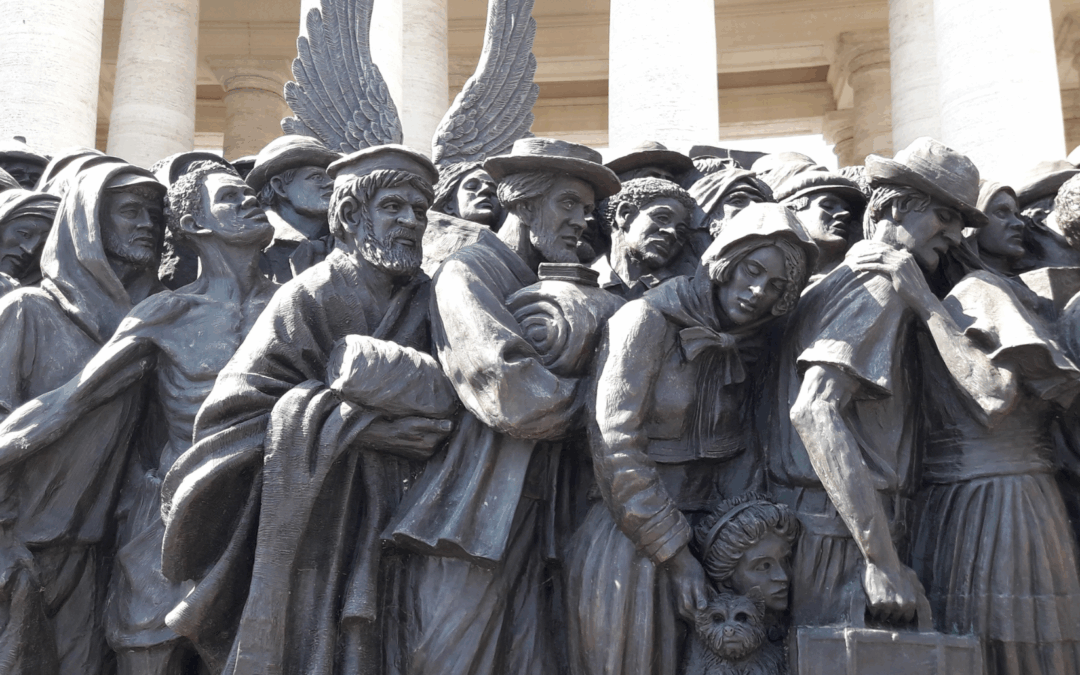
Image: “Angels Unaware” by Timothy P. Schmalz. This bronze sculpture was commission by the Vatican and unveiled in St. Peter’s Square in 2019. It depicts 140 migrants and refugees throughout history huddled together on a boat.